
By Cătălin Andrei Bora · Founder, re:solved
Software Services Are Dead. Long Live AI Agents.
re:solved was born as a software company. Today we're announcing the end of one era and the dawn of another — in the same breath.
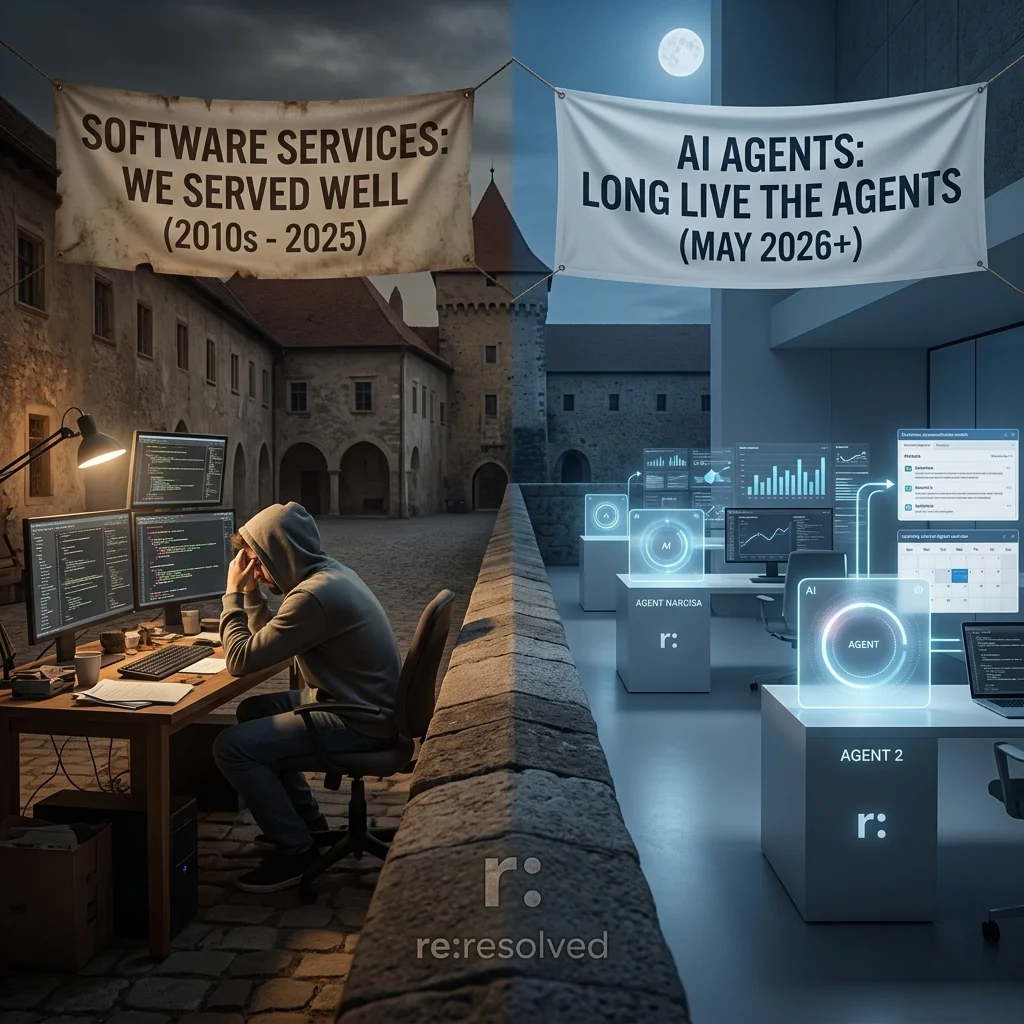
In medieval times, when a king died, heralds would ride through every town crying: “The King is dead! Long live the King!” — announcing the end of one era and the dawn of another in the same breath.
We're not heralds. We're a two-person company in Romania. But we are making the same announcement.
re:solved was born as a software company. We built SaaS products, managed codebases, shipped features, and maintained systems. We were good at it. But the model — humans managing tools, maintaining code, selling subscriptions — is entering its twilight.
What replaces it isn't a better tool. It's a fundamentally different kind of worker.
The difference between software and an agent
Most business software does one thing: it waits. It waits for a person to open it, click something, fill something in, make a decision, hit send. Without a human at the wheel, it sits there.
An AI agent doesn't wait.

An agent is software that acts. It thinks about what needs to happen, decides how to do it, and executes — on its own, on a schedule, or in response to a trigger. It doesn't need someone to open a dashboard. It doesn't need a reminder to follow up. It doesn't stop working at 6pm.
This is not the same thing as a chatbot sitting in the corner of your website, waiting for someone to type “help.” And it's not a copilot that suggests edits while you do the real work. An agent is closer to an employee who never forgets, never gets tired, and never needs to be told the same thing twice.
That's the shift. Software was something you used. An agent is something that works for you.
Why this matters if you run a business
If you're running a company with 5 to 30 employees, you've probably experienced this pattern:
A task keeps piling up. Following up with leads. Scheduling appointments. Posting on social media. Compiling weekly reports. So you hire someone to handle it. Then another task piles up. You hire again. Eventually, a third of your payroll is covering work that is repetitive, predictable, and manual — the exact kind of work an AI agent can take over.
The problem was never that your team wasn't working hard enough. The problem was that until very recently, the tools available to small businesses weren't good enough to trust with real operational work.
That's changed. And it's changed fast.
Today, a properly configured AI agent can:
- Contact former customers on your behalf, notify them of new offers, and invite them back — without anyone on your team touching it.
- Handle your bookings — appointment requests, confirmations, reminders, rescheduling — 24 hours a day.
- Run your content calendar — research topics, draft posts, and publish them on schedule, so your online presence doesn't go dark the moment you get busy.
- Follow up with every lead the instant they come in, qualify them, and keep the conversation going until a human needs to step in.
These aren't hypothetical. These are agents we've built and deployed.
We didn't just start selling this. We built one for ourselves first.
Before we offered AI agents to a single client, we built one internally. Her name is Narcisa.
Narcisa is re:solved's own AI agent. She handles our strategic research, drafts content, selects brand assets, and publishes posts on our behalf. The LinkedIn announcement that preceded this blog post? Narcisa researched the strategic shift, wrote the copy, generated the image, chose the brand assets, and published — without a single human typing a word.
That's not a demo. That's our own product running in our own business, on our own problems.
We believe that's how it should work. If we're going to tell you that an AI agent can handle your operations, we should be using one to handle ours.
The part most providers won't tell you
Here's the thing about most AI automation: it runs in the cloud. Your business data — customer lists, internal communications, scheduling details, sales figures — gets processed on someone else's servers. For a lot of businesses, that's fine. For others, it's a dealbreaker.
If you work in healthcare, legal, finance, or any industry where client data is sensitive, cloud dependency isn't just inconvenient — it's a compliance risk.
re:solved can deploy AI agents on your own hardware. On-premise. Self-hosted. Your data never leaves your building. No dependency on third-party cloud providers, no vendor lock-in, no surprises when a cloud provider changes their pricing or terms.
This isn't a common offering. Most AI automation companies are cloud-only. We think that's a gap worth filling.
What this doesn't mean
Let's be clear about a few things.
This doesn't mean firing your team. An agent replaces the repetitive parts of work — the follow-ups, the scheduling, the data entry, the reporting. It frees your people to do the work that actually requires a human: judgment, relationships, creativity, leadership.
This doesn't mean you need to understand AI. You don't need to know what a large language model is. You don't need to learn a platform. You describe the problem, we build the agent, and we keep it running on a monthly plan. You interact with the outcome, not the technology.
This doesn't mean it works for everything. Some problems aren't agent-shaped. If the task requires deep contextual judgment, emotional intelligence, or physical presence, an agent isn't the answer. And if that's the case, we'll tell you. We'd rather be honest about the limits than oversell the capability.
How it works in practice
Our process is simple because it should be.
First, we audit. A free conversation where we map your operations and find where time and money are leaking. We're looking for the tasks that are repetitive, manual, and predictable — those are the ones an agent can own.
Then, we build. Not a generic tool. Not a platform you have to learn. A custom AI agent configured around your specific problem, integrated with the tools you already use.
Then, we manage. On a monthly plan, we monitor, maintain, and improve the agent as your business changes. You don't have to touch it. You don't have to think about it. It runs.
The whole engagement starts with a question: what's costing you time that shouldn't be?
The era has already shifted
We're not predicting the future here. We're describing what's already happening. Businesses that used to need three people to manage bookings, follow-ups, and social media are now handling all three with agents — at a fraction of the cost, around the clock, without the inconsistency that comes with manual work.
The companies that move early on this aren't the ones with the biggest budgets. They're the ones who are most frustrated with the status quo — the ones who are tired of hiring to solve what should be a software problem.
Software services had their era. They served businesses well. But the next era isn't about better software. It's about software that works without being told to.
That's what an AI agent is. And that's what we build.
Related reading
- What to Look For in an AI Automation Agency (+ Red Flags)
A practical buyer's guide for founders: what to ask, what to verify, and how to tell a partner that runs your operation from a vendor that ships a slide deck.
- Two rules, both correct: what the EU AI Act actually asks of a business using an AI assistant
European law says a conversational system must tell people it isn't human. A client's brand guidelines said never sound technical with patients. Both rules were correct. Here's how we resolved it — and what the AI Act actually asks of an ordinary business.
- AI Automation for Law Firms: Legal AI Agents That Keep Client Files On-Premise
Client intake, document triage, deadline chasing: the most automatable work in a law firm is also the most confidential. Here's how self-hosted legal AI agents handle it without privileged files ever leaving your infrastructure.