
By Cătălin Andrei Bora · Founder, re:solved
What an AI agent costs for a company in Romania
Three sums on the table: what you pay once, what you pay every month and the cost that shows up separately, per message. With the figures from a month of work by an agent running today.

The question usually comes in the first five minutes: "Fine, and what does it cost?" And the answer most owners get is "it depends".
It does depend, but not so much that it cannot be written down. Below are the sums we work with, what each one covers and what is paid separately.
The short answer
| Step | What you get | Price |
|---|---|---|
| Conversation | 30 minutes on one process in your business | Free |
| Specification | The exact plan for the agent, with a fixed price and a start date | 400 EUR |
| Build | The agent, connected to your systems | From 1,500 EUR |
| Monthly run | Monitoring, a weekly report, corrections, improvements | From 250 EUR a month |
If the agent writes on WhatsApp, the cost of the messages is added, paid to Meta. More on that below, with figures.
What you pay once
The specification costs 400 EUR and takes half a day on a single process. At the end you have on paper the steps, the systems that get connected, what the agent does and does not do, when it hands over to a person, the fixed build price and the start date. If you sign the build within 60 days, the 400 EUR is credited against the price. If you already have a DIGIVEST strategy or feasibility study, the specification is free.
The build starts at 1,500 EUR. The exact price comes from the specification and stays fixed. It does not grow along the way. It is paid in two halves: half when you sign, half when the agent goes live. You receive the price itemised by component, which is also useful if you want to put it in a funding application.
What you pay every month
The run starts at 250 EUR a month. An agent is not installed and forgotten. Someone has to look at what it did, correct what did not work and adapt it when something changes in the business. That is what the monthly run covers:
- monitoring the agent;
- a weekly report of what it did;
- corrections, when an answer was not the right one;
- improvements, as new situations come up.
The monthly running fee also pays for our own conversation reviews and adjustments to process steps and rules without waiting for a request, because we know what the client wants from the agent; corrections come from our review or the client’s suggestions. At Multidiet, in November 2026, one handover message reached the clinic team but the attached documents did not go through. We caught it in our own review and corrected the handover, and the issue is solved.
If you later want the same agent to take over one more process, that adds 100 EUR a month.
The cost that appears in no quote: the messages
This is where many budgets go wrong. WhatsApp for business is not free. Meta charges for the messages a company sends first, while replies to a customer who wrote to you are, for the most part, free.
As an order of magnitude, from an account we run: in a month with roughly 1,400 delivered messages, the Meta bill was about 90 EUR. That is around 6 to 7 euro cents for a message that opens a conversation.
Source: WhatsApp Business pricing, on Meta's site
The amount is paid directly to Meta, from your company's own account, and you see it separately from our invoice.
An agent that only answers enquiries coming from customers has a message cost close to zero. An agent that starts the conversations itself, for example with past customers, has a cost that grows with the number of people it writes to. It is worth knowing in advance.
What a month of work looks like, in figures
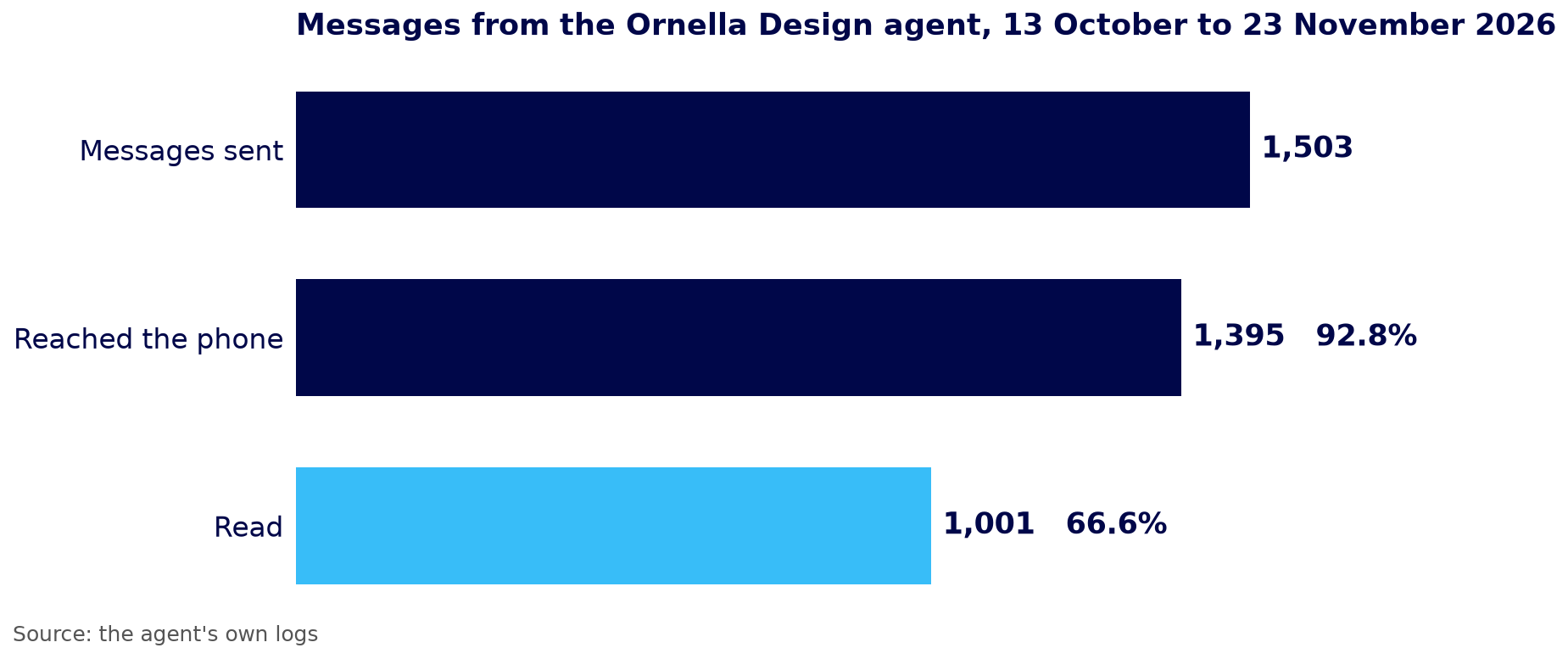
A price says little without the volume behind it. Here is what the agent we run for Ornella Design, a print shop in Timișoara, did between 13 October and 23 November. These are activity figures, taken from the agent's own logs: what it sent, what it received and what it handed over.
- It wrote on WhatsApp to 1,503 customers from the print shop's list, in 11 batches.
- Before sending, it removed 55 rows from the list on its own: wrong numbers, landlines and duplicates.
- 92.8% of the messages reached the phone, and 66.6% were read.
- It received 143 messages from 88 people and handled every one of them.
- It sent 125 replies.
- It handed 6 requests to the sales team, among them menus, 3D lettering, window film and christening envelopes. All of them reached the right person and were read.
- Anyone who asked not to be contacted again was removed from the list on the spot, automatically.
One detail that matters more than it seems: the agent did not invent a single price. Where the request was custom, it stopped and handed it to a person, with everything it had learned up to that point.
What happens after handover, including the offer, order and value, is not yet part of the agent’s reporting. Connecting those outcomes is the next step.
For a business, this means a list of 1,500 past customers was worked through in a few weeks, without anyone on the team writing a single message.
The other kind of agent does not write first, it answers. Kara, the agent for Multidiet, handles WhatsApp questions from people interested in the programme. The first real message arrived on 13 October at 22:13. In the first six weeks there were 9 people and 176 messages, with a median first reply of 6.5 seconds and nine in ten substantive replies under 15 seconds. The median conversation has 18 messages. Kara checks required lab tests are present without interpreting values. Meta message costs are close to zero for replies to incoming customer enquiries.
Who this is about: Ornella Design · Multidiet · About us
Why we write "from" and not a fixed sum
Because two agents that sound the same can be very different pieces of work. Three things move the price:
- How many systems get connected. An agent that reads from one place is simpler than one that links WhatsApp, email and the order system.
- How many exceptions the process has. The more situations where "it depends", the more rules there are to write and test.
- How often it happens. Ten requests a week and three hundred a week do not need the same care.
That is why the exact price is set in the specification, after we have looked at your process, and does not change from there.
How to tell whether it is worth it
You do not need a complicated calculation. Take one task that repeats and note two things: how many times it happens in a week and how long it takes each time. Multiply, then set beside it who does it and what else they would have done in that time.
An example, with figures we chose to make it easy to follow: 40 questions a week about order status, at 6 minutes each. That is 4 hours a week, or around 17 hours a month, taken from the person who should have been preparing quotes. Add to that the time lost each time getting back to what they were doing.
If you want a first estimate on your own numbers, the 3 minute test shows what the business loses each month and which agents would fit.
An estimate on your own numbers: Take the 3 minute test
When an agent is not worth it
There are situations where we tell you not to build:
- The task comes up a few times a month. A person handles it faster than it takes to write the rules.
- Every case is different and needs a decision. An agent is good at what repeats, not at what gets negotiated.
- The information it needs is not written down anywhere. If the answer lives only in someone's head, it has to be put on paper first.
In all three, the 30 minute conversation is enough to find out.
Five questions to ask anyone who sends you a quote
Whoever you work with, ask for an answer to these before you sign:
- Is the build price fixed, or billed by the hour?
- Who pays for the messages, and what does one cost?
- What is included in the monthly sum, and what is paid separately?
- What happens when the agent does not know the answer?
- Who looks at what the agent does after it goes live?
If you get a clear answer to all five, you know what you are buying.
Frequently asked questions
Are there hidden costs?
Not with us. The build has a fixed price from the specification, and the run has a monthly sum. The only cost that depends on volume is that of WhatsApp messages, paid to Meta, and we estimate it in the specification.
Can I start with one process?
Yes, start with one defined and tested process. Expansion comes only after you see that it works.
How long until the agent goes live?
The build takes 2 to 3 weeks, but for our first clients the time from signing to launch was 2 to 3 months. The difference was not technical: it was the time spent clarifying the process with the client’s team, through meetings, tested alternatives and corrections. The clearer the process is described at the start and the more time someone in the company has for it, the sooner launch comes.
Can I use funding or a digitalisation programme?
Yes, the build price is itemised by component so it can be included in a funding application. The specification is free if you already have a DIGIVEST strategy or feasibility study.
What happens if I want to stop the agent?
We stop it at any time, at your request.
Why is a tool I configure myself not cheaper?
It can be, at first. The difference shows after go-live: who connects it, who looks at what it does and who repairs it when something changes. With us, those are included in the monthly run.
Sources: WhatsApp Business Platform pricing
Related reading: What to look for in an AI automation agency · What is an AI agent, actually?
Related reading
- What to Look For in an AI Automation Agency (+ Red Flags)
A practical buyer's guide for founders: what to ask, what to verify, and how to tell a partner that runs your operation from a vendor that ships a slide deck.
- Two rules, both correct: what the EU AI Act actually asks of a business using an AI assistant
European law says a conversational system must tell people it isn't human. A client's brand guidelines said never sound technical with patients. Both rules were correct. Here's how we resolved it. And what the AI Act actually asks of an ordinary business.
- AI agents vs. Virtual assistants: which one should you hire for repetitive work?
If the job is follow-up, bookings and inbox triage, you're choosing between a virtual assistant and an AI agent. The comparison covers cost, hours, consistency, data security and when a human is still the right hire.